Author: coachmessam
The Rock Road to somewhere
Purpose and intent
The drive over was packed full of thought and imagination, I had watched the SuperBowl, an annual ritual that never fails to leave me stunned at the glitz and glamor of it all. This, alongside a weekend of games that resulted in some very interesting successes and I was somewhat at odds with my practice. I know, I am sounding like a scratched record (vinyl for those not quite old enough to know what it is I am talking about), coach is on the cause and affect debate again! It is just that I am keen to get to a point where I understand my interactions, my behaviour and the impact of what I do and say on the young people I work with.
I arrived at practice not having had a great amount of time to plan, the time I had set aside was gobbled up by a very interesting conversation with one of the UK’s bright young coaches. This being said, I was confident in what it was I wanted to focus on tonight and was comfortable with our content. We started by revisiting the previous game, a moment to congratulate a young man for his success and to highlight ‘Who We Are’. The players shared in his smiles and gave him a metaphoric pat on the back, it was a great moment. We then moved on to the scout, everybody contributed to the ‘painting of the picture’, revisiting prior knowledge in order to map out what it did and would look like. The mood seemed relaxed, everybody was engaged and attendance was good. We were ready to go!
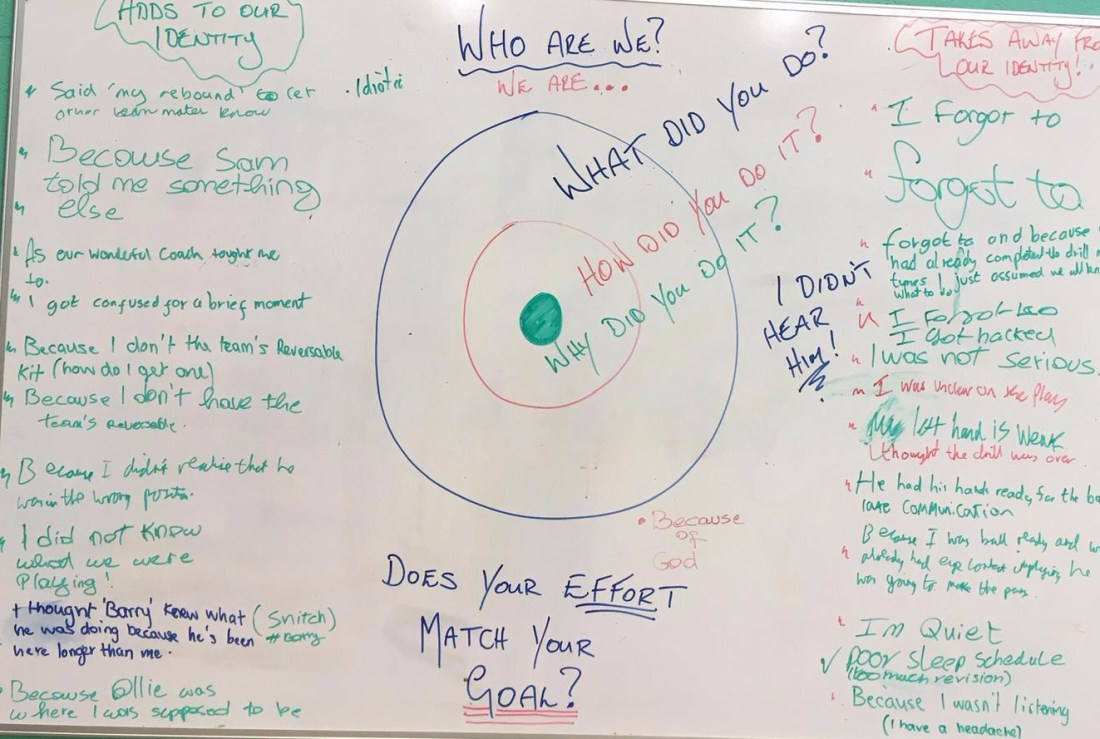
I had wanted to focus our attention on execution and the need for communication in order for us to realise our potential. We utilised our Golden Circle model to challenge communication – the purpose and intent. We discussed what each was (early, loud, direction and action), agreed when and where we should be ‘talking’ and set about putting it into practice. It was at this point that the landscape that stretched out in front of me began to look baron, no longer could I see crisp passing out of stance, well-communicated movement, early identification of movement and all the things that my vista should include. However, I was mindful that I was looking through my lens, projecting my opinions and aspirations on the setting. In an attempt to regain some sense of what we were doing and why, I stopped one player and asked him why he didn’t communicate his movement. His response was short, “I did coach”. On further examination the player did indeed communicate his movement, he just wasn’t loud, it just wasn’t the way I had intended. Surely that was the key, what it looks like and what it is are sometimes just not quite aligned. In fact, I would argue that this is the point in coaching where the relationship is tested, where flexibility and understanding are required.
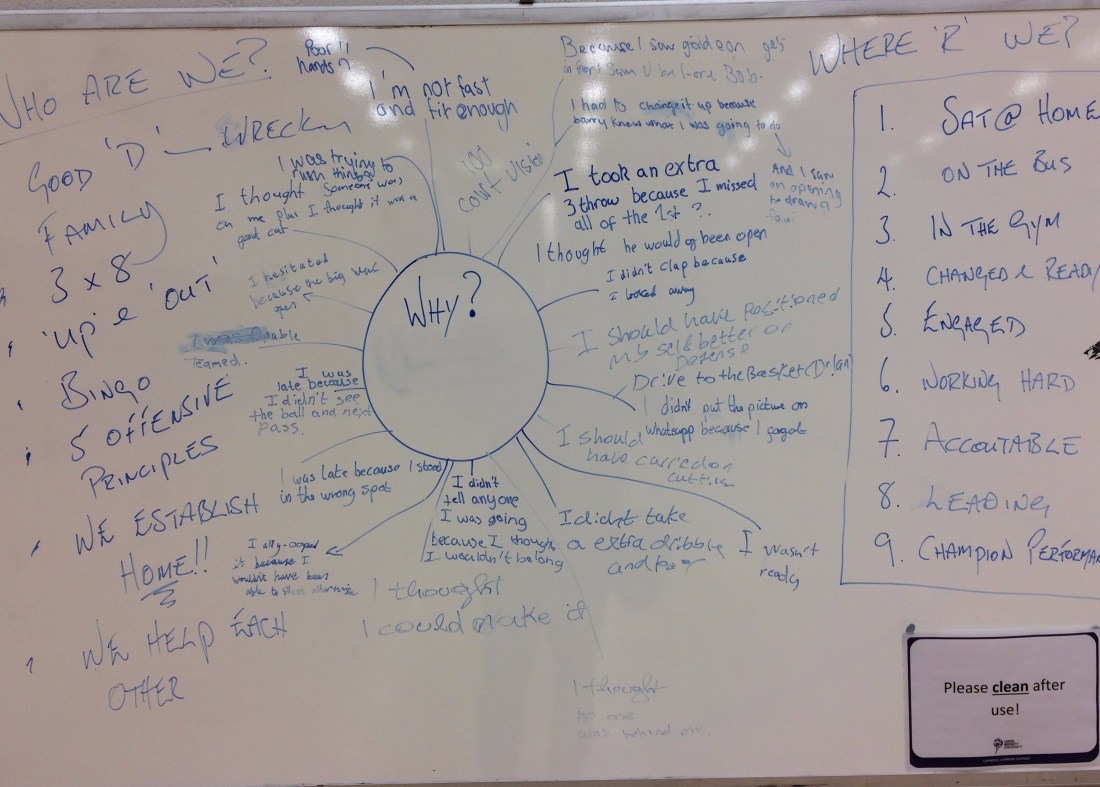
Looking back at the session, the boys worked hard, they made a tremendous effort to do something that perhaps didn’t come natural to them, to communicate in a leadership voice. To project a sense of confidence in their ability and to demonstrate their understanding of Who We Are. What it was I was asking them to do was far greater a task than I had considered. More importantly, how effective am I as a communicator? I would suggest that I have my moments but there is a great deal more I could and should be doing to improve the communication lines within our interaction. We sparingly utilise social media, mobile Apps and electronic mail to share ideas, focus in on a topic or area of interest. In addition, I have taken to utilising the white board as a means of providing pictorial / infographic type illustrations of key messages and working through our two key questions – ‘Who Are We? and Where Are We? But the point is, is it enough? Am I promoting, facilitating and presenting opportunities for players to be comfortable communicating with each other? Tonights session had left me wondering ‘where was I?’ Had I communicated enough? There wasn’t a buzz, a sensation that I get more often than not pre and post practice. I wasn’t communicating with self!
The drive home was somewhat empty, I don’t recall revisiting any part of the session. I wasn’t sure why, or even what it was specifically that had led me to this. Perhaps it was the lack of planning and so the feeling (or lack of) was due to not knowing what we had achieved? I arrived on the drive, left my car and climbed the stairs to my home office. Perhaps tonight was just one of those nights and all would be well tomorrow?
Five chairs – five choices
Having recently used the Five Chairs – Five Choices model within a seminar to highlight the concept of coaching styles (from a leadership perspective) I am mindful of some of the messages that emerge from the work of Louise Evans. The model addresses cultural intelligence, our ability as leaders / managers (and I suggest, coaches) to work effectively with people. Reflecting on my coaching practice, how I approach each individual relationship, each interaction and each moment often raisers the question of effectiveness. Do I move to a protective state where I assign blame, attack and defend my position as coach? Or, do I have vision in my practice, am I able to empathise and display compassion? I would suggest, like many others, that coaching does not reflect one single ‘style’ or mode of practice, rather, we move through a range of emotions, states of being and behaviours that have an impact on our charges. We have the power to influence their perception of the relationship we have and the effectiveness of the interaction as a result of the connectivity that exists within our being together.
Five Chairs:
(RED) Jackal – punish, judge, complain, attack, a judging position, I am right position
(YELLOW) Hedgehog – vulnerable, protective mode, self-judgement, self degradation self-doubt, lack of confidence
(GREEN) Meerkat – mindful, thoughtful, curiosity, choice
(BLUE) Dolphin (detect) – detective to ourself, self-awareness, vision, voice, create boundaries, retain power, freedom
I often think through these and many other concepts as a means of informing my behaviour, the way I coach and the influence I have with my players. Today was very much one of those days. I spent a little bit of time prior to the start of the game talking to players individually. I wanted to empower them, give them a sense of confidence and ‘permission’ if you like, a license to play freely and do what they felt was an reflection of their very best. Having spoken to them individually, I took my place on the bench and did everything I possibly could to remain quiet, to allow the players to self-organise, to contribute through the execution of their role and to be supportive.
We got off to a good start, executing our now patented style of play, ‘Run-Press-Run’ (adapted from Coach Xavier, Nottingham Knights), sharing the basketball and communicating both the intent and purpose (at times). I sat quietly, using the opportunity to gather some stats, again, in the hope that I would be able to use them as a means of demonstrating Who We Are! The game continued to play out, the result was inevitable, however, I was more concerned with what we were doing and how we were doing it. My challenge had been a simple one, could we establish ‘Who Are We?’ Could we be US? It was important for all twelve players to get into the game and experience substantial minutes today, to act out their role and be who they wanted to be. With this in mind I said very little, accept for in the third quarter. The pressures, unpredictability and opposition really do direct our behaviour as a coach, something my research is beginning to tell me. I had my moment and then returned to my state of observation and recording.
At the conclusion of the game, our third gathering in three days, the boys had done well to explore their identity, to enact their individual and collective goals with a degree of success. Could we do better? Yes, sure we could, but for now, the effort (Where Are We?) had been good (engaged and leading) and we had shown that we did understand a lot of what and who we were trying to be. Of what our game model comprised of and how best to employ the various elements with success and energy. The boys had played well and I was happy with our direction of travel. We would continue to work towards our next challenge, a harder challenge, but one that I felt we were going to be ready for and that we would enjoy.
Friday night again
I haven’t yet gotten used to the idea of driving over to the University for a Friday night fixture, the roads aren’t the same, the traffic is different, it just all feels somewhat outside of my routine!
I arrived forty-five minutes before tip, the players were busy setting up the court, talking with each other and generally being self-organised. We were due to play our second team tonight, a concept that could be debated each way for a number of hours. I tried to stay away from the whether or not the appetite for such a concept was an healthy one or not and focus on demonstrating respect whilst trying to work through our game model. At this point, I should highlight that there are several teams between us and the second team in the league and so I had anticipated ‘A’ but gotten ‘B’.
They were all over us, we couldn’t make a pass, execute a dribble or even get into anything, we were sleep walking (not even in the gym yet) whilst they were engaged, moving and leading, 16 – 8! I was firm in my time out, addressing only two things, our levels of effort, which we should have been aware of as I had been asking ‘Where Are We?’ We clearly scored low on our scale of effort and it was showing. My second point was also a simple one, work together to find ‘us’, regain our identity (Who Are We?) and begin to play the way I know we can. I wrapped all of this up with a short sharp statement – Go find us!
The players exited the time out with a renewed sense of purpose, their levels of communication escalated, both on the court and on the bench, and we began to be us – running, defending, hustling and doing it together. I returned to my seat and continued to try and take stats whilst coach, not something I would normally do but then I was experimenting with a self-coaching approach to the game, allowing players to control our game model and direct our play on the court. I wanted to be able to give them a snap shot of Who We Are, a picture by numbers as a means of illustrating what we do. As a club, staffing was a difficult area of work, we couldn’t find volunteers to complete game stats for us and so had to do without. Hence, the decision to have ago myself and hopefully provide something the players could learn from.
We eventually got hold of the game and ran out winners, however, the taking of stats had served to change our approach somewhat, we had become aware of our individual performances, there was a selfishness that had crept into our play in a bid to take hold of the top scoring spot. I didn’t like it one bit, it was obvious and it was something I was going to have to address. For now though, we finished out the game, exchanged congratulations, as you do, and I made my way home. It would be a short turn-around and I would be back at LBU, back on the side line and back supporting these twelve players.