Learning from learning

The focus of one of my undergraduate lectures today was the importance of communication, with a specific slant towards defining the act and how communication translates into instruction. An interesting debate was had following a game of charades and Chinese whispers. In fact, during my drive over to practice I began to consider my own ability to communicate a message, offer some instruction, and most importantly of all, listen! During our last game I had been asked the following question: “coach, what can I do better?” Is there a more loaded question? I tried to recall my response, it was brief, punchy and motivational, to a point. What it wasn’t however, was instructional. There was no specificity within my response, I didn’t identify a skill, task or area of responsibility that could be improved my means of… I merely suggested that the player take up a slightly different position on the floor and look to utilise his strength and speed. On reflection, my response should have been a probe, a question back at the player asking him to consider what it was he thought he should be doing. Following this moment I knew I had to be better, I wanted to be clearer in my communication and so committed myself to addressing the sending of some of our key messages prior to our practice tonight.
We spent twenty minutes constructing a pictorial representation of our philosophy, game model and goals for the season. It was interesting just how many players knew what we were trying to do in each moment of the game, and more importantly, why. The session went well, it was light in nature, but served to recall, revisit and reaffirm what we hoped to achieve. As we moved into our physical practice I felt confident that we’d had a positive twenty-minutes and would benefit from the exercise at a later date. We got into some movement and shared shapes in a bid to revisit and embed our various patterns, almost a marginal gains approach. I allowed the players to explore where it was we could improve our play, tighten our execution and benefit from quicker movement, sharper turns, greater communication and a deeper understanding of what it was we were trying to achieve. The practice looked age appropriate, it had all of the moving parts, a court, a ball, a coach and some participants. The question was, how much learning was taking place?
What strikes me as interesting, both on the court and in the lecture theatre, is the concept of cause and affect. How do we know when we have affected change, promoted thought or sparked understanding. At what point does my instruction, observation or feedback cause the player to grasp the concept, to better understand their role within a collective movement? I obviously appreciate learning theory (pause for the sound of the trumpets) and have been recognised as being excellent (#National Teaching Fellow). I would state, if asked, that I subscribe to a social constructivist methodology, that is to say that I encourage and promote dialogue among the players (I believe I do), I present our concepts in various forms (written and verbal models, self-discovery, problem-solving and questioning scenarios) and provide time and space for them to explore our gamecraft on their own, to problem-solve and to ask questions of each other. My query is this, at one point does it become a reality for them? When is it that the ‘light bulb’ moment occurs and when can I say that it is because of something I did, an instruction or merely the provision of opportunity to learn? I would argue that my students have moments of understanding outside of the formal learning spaces that we share, that they obtain some degree of understanding whilst sat in a private learning space, either sharing this time with peers, or immersed in the reading that is positioned in front of them. I guess what I am saying is this, if we all learn in our own private learning spaces, I would like to know what this space looks like for a U16 basketball player and how I can contribute to that learning. Or, more importantly, do I need to contribute to that learning space?
I drove home knowing I would be back the following day, that I would continue to be curious and that I would further want more from my coach self. Some of us had come a long way and I was pleased to see that growth. However, some of us hadn’t yet had our ‘light bulb’ moment and that was a source of frustration for me, a point that I wasn’t sure of but knew that there was more that I could be doing.
Who ‘R’ We?

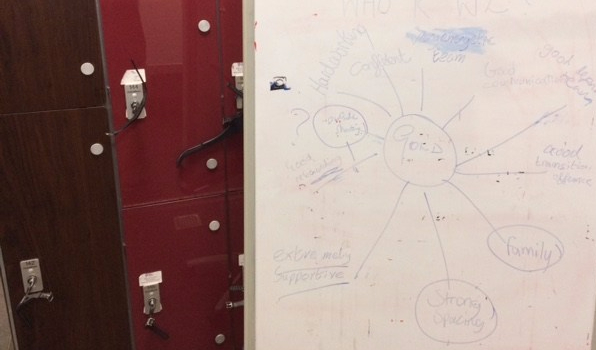
I felt as though we had prepared pretty well and had secured a game plan that we could live with. We had focused on one element of our team defence and made an effort to address the mechanics and execution as a means of achieving a marginal gain. I currently work from a pretty simple base, we try to do three or things really well as oppose to doing lots of things not so well. In fact, upon my arrival at the venue we spent fifteen minutes in the pre-game discussing who we were. I asked the players to each write on the board exactly who they thought we were. I was impressed with the ideas that flowed freely and confidently from them and the manner in which they each shared their ideas. We debated the various descriptors, exploring what each meant to us as a team and how we felt we demonstrated them. As we left the changing rooms the scene was almost on a par with the emotional exiting of the locker room following the very motivational speech given by head football coach Al Pacino in the movie ‘Any Given Sunday’.

We got out to a great start, one of the descriptors that emerged in the changing rooms was a good ‘running team’, and did we run? We were wide on our attacks, the ball moved at pace and freely up the court as we advanced towards the basket in waves. In fact, we started the game 10 – 0, including a trip to the free throw line, a three pointer and three lay ups. I couldn’t ask for better ball movement, player movement or indeed better shot selection. What followed however was a complete ‘left side’ attack. We suddenly changed the way we played, collectively we began to make gigantic mistakes, lose our confidence and fail to contain the ball. My frustration quickly grew and I began to let the team see first hand how I felt about our current bout of play. I was, by far, the loudest I had ever been with them, I was firm, forthright and disappointed and I let them know. In fact, I would say that everybody in the sports hall knew how I was feeling. Not a behaviour I was happy with or even content in displaying, however, the response was positive, we picked our play up again and began to return to a dominating position, one that played aggressive defence, applied pressure on the ball, filled the passing lanes and took advantage of errant passing and sloppy ball handling.

By the end of the game we had amassed a sixty point advantage, our play wasn’t always as ‘tight’ as I would have liked, however, our overall level of confidence was pleasing to see and much of our performance was effective. We had executed at both ends of the floor, played together and shown that we could be who we said we were. I knew the players were happy with themselves and that pleased me, they deserved to be, they had worked hard and had enjoyed being the dominant team. Could they lift their level of play even further? I believe so and now wanted to find a way to provoke further improvement, both individually and collectively, as a means of advancing who we were.

In the middle of all of this one of my players had somewhat of a melt down. He took offence at the manner and content of my instruction. In hindsight, I had not expressed myself clearly enough and we sat and discussed the matter for a while. I respect the player a great deal and hold promise for who he could be and where he could get too within the game. I did however feel that he had to deal with our situation in a manner that displayed maturity and an ability to mentally overcome difficulties and move on to the ‘whats next?’ It took a little bit of doing but we got him ‘back’, he acknowledged his part in the misunderstanding and we moved on. It was also a great learning moment for me, a point where I realised that I needed to be a better communicator and hold a better relationship with each and everyone of the players.

The drive home was a pleasant one, we had gone to 10 – 1 on the season. However, more importantly, we had demonstrated that we could be who we wanted to be, that we could compete at an elevated level of performance and that we could do it together as a team. It had been a good day, the players had done themselves proud and we had also managed to play a little basketball along the way.

The wannabe artist remains in the building

In an attempt to move myself forward into the twenty-first century I had begun to engage with the concept of Podcasts, a statement that I am confident will sound redundant to the masses, yet I offer it as a proclamation to the New Year and the improved coach in me. In doing so, I stole a part of my morning listening to a coach development offering from a respected UK based basketball coach. Unfortunately, the coach did not feature in the contemporary landscape of practice, at any level of performance, or within the development field for which he is so often remembered. The coach put forward a number of interesting concepts regarding the journey in to coach development, many of which are argued within the literature to be common ‘moments’, experiences and generally a pattern of learning engaged in, to some extent, by the majority of coaches. The programme forced me in to a revisit of my own coach journey, and more, to what it was I currently sought. I have persistently verbalised my wish to improve, to be more effective and to advance my practice as a coach. To this end I have engaged in various opportunities to improve my coach self, yet it appeared that I was still not content with my lot. I make this point as I feel as though it reflects on my practice and my pursuit of the ‘flawless’ session, the perfect game and the pristine delivery of my coaching.

I arrived at our training facility ‘buzzing’ (a popular word among my students’ and one that I shall employ as a statement of youth), ready to engage with the players and take them on a journey. I wanted to improve our ability to reduce penetrating moves, in short, I wanted us to guard the ball better. We started with some uptempo hustle drills, an opportunity to raise the players pulse and intensity in a competitive manner. The activities were well received, the players engaged in various competitive attempts to achieve the tasks set and demonstrate their ability to execute the various skills (shooting, rebounding and passing). I then proceeded to construct various scenarios, disadvantage-based that forced the defender(s) to communicate, to make decisions and to employ high degrees of effort in order to achieve a minimal return. A return that we sought within our game model and that would lead to improved team defence. Again, the players’ gave it their all, they encouraged each other, they retained a sense of game-based reality within their execution and they sought to improve throughout each repetition.

As we moved into our reenactment of competition I was eager for the players to reproduce what they had constructed within the small game-based scenarios. I felt that this would really signify a resounding success and a high degree of achievement towards our session goals. However, I didn’t quite get what it was I was looking for, the effort was there but the execution, at times, had gone somewhat missing. I became impatient and stopped practice to make the point that we were not where we wanted to be. That what we currently had to offer would not be enough. On reflection am I going to suggest that both statements were somewhat unfair and perhaps didn’t hold much water. I had however, returned to my vision, my Sistine Chapel, a bricolage of ball and player movement, aggressive cuts to the basket, constant displays of confidence through communication, physical presence and solid decision making, all of which achieved iconic standing and equaled only by the ranks of the junior national teams.

I once more took the drive home listening to the stern words of my inner coach self, the central theme of the discussion was a simple one, a greater degree of reflection in action would allow for a more objective rendering of my canvas. Patients would be a key trait to develop within my practice. Why? Because we had set our parameters, established our goals and moved towards the task of achieving said goals with enthusiasm, commitment and a sense of pride. Could I ask for more? Should I ask for more? Or perhaps I should merely change the lens with which I view my work?

My Sistine Chapel

The focus of one of my undergraduate lectures today was the importance of communication, with a specific slant towards defining the act and how the process of communication translates into a prominent coaching behaviour – instruction. An interesting debate was had following a game of charades and Chinese whispers. The games served as an appropriate introduction to miscommunication, the loss of the meaning within the message as a result of poor transmission and sparked a number of questions regarding our ability as coaches to formulate and send effective communication within the coaching environment. In fact, during my drive over to practice I began to consider my own ability to communicate a message, offer some instruction, and most importantly of all, listen!
During our last game I had been asked the following question: “coach, what can I’d do better?” Is there a more loaded question between coach and athlete? I tried to recall my response, it was brief, punchy and motivational, to a point. What it wasn’t however, was instructional. There was no specificity within my response, I didn’t identify a skill, task or area of responsibility that could be improved my means of… There was limited, if any, skill correction, tactical adjustment or role clarity within my response, I merely suggested that the player take up a slightly different position on the floor and look to utilise his strength and speed. I wanted to be clearer in my communication, in fact, I needed to be clearer within my coaching if I was to be effective. I was going to address this within our key messages prior to our practice tonight, and did through the development of a ‘picture’.
I sat the players down in a small corner of the gym and we spent twenty minutes constructing a pictorial representation of our philosophy, game model and goals for the season. I asked questions, presented clues and probed the initial thoughts of the players responses as a means of supporting them to arrive at the answers. It was interesting just how many players knew what we were trying to do in each moment of the game, and more importantly, why. We laughed, revisited and mused over what we did well, what we needed to improve on and how we wanted to realise this mid-season epiphany. The session went well, it was light in nature, but served to recall, revisit and reaffirm what we hoped to achieve. As we moved into our physical practice I felt confident that we had just completed a positive twenty-minutes of bonding and would benefit from the exercise at a later date within the remainder of our time together.
Practice was a high intensity affair, lots of challenges, moments of accountability and opportunities to build on our reflective session. The language being used by the players throughout the session was very much inline with the pictorial representation we had constructed. All of a sudden players were using words such as ‘gap’, 3×8, WRECK etc., all of which featured as cues, acronyms and prompts to recall our philosophy and game model. As the players moved through the various drills and game-based activities I removed myself, inch by inch, in a bid to allow them time and space to further explore our game model and to promote self discovery. I felt a little distant at times, removed from any developmental progression within our style of play and decision making. Slowly but surely I became impatient, the session no longer looked like I wanted it to, the sharpness, as in my definition of our game model, had been replaced with long slow cuts, poor passing, lack of vision and inefficient movement. I called the players in and challenged them to find their ‘Sunday best’, a phrase I had employed frequently throughout the season as a means of visualising their greatest effort, their most profound levels of concentration and their best output. Had I been too quick to judge? Was it that in exploring and discovering I had wished for a flawless version?
I exited practice happy with the effort of the players, a point I expressed prior to our departure. They had indeed worked hard, they were aware of much of what it was we were hoping for each and every time we stepped on to the court. Did it always look how I felt it should? Should it always look like I want it too? I believe the answer remains in the question and it is for me to untangle.

Game on

I had managed to contract the beginnings of ‘man flu’, more scientifically known as a viral infection, but no less deadly in its assault on my ability to function. I arrived at the venue in good time, we were getting dressed and appeared pretty relaxed. The Lions were a good team and we could not afford to take them lightly at all, in fact, we had only won one game more than them and so I envisaged a close hard fought game.

We warmed up pretty well, I had now settled into the fact that they could and would conduct their own warm up, that they had a number of routines that belonged to them and I was happy for this to the case. After all, what was the warm up for? Did it really serve to engage them physically and mentally, to move them to a state of readiness where they could visualise shots, recall concepts and get themselves performance ready? It was once more the battle between affording autonomy and confidence in what the collective felt was right, and dictating what should occur in order to be completely satisfied that we had done all that we could within our pre-game preparation to get us to a point of readiness.

We fought hard for forty minutes, it wasn’t always pretty, in fact, it was rarely pretty! Scrappy would have been a good descriptor, some of it good as we introduced ourselves to the floor in an attempt to rescue lose balls, to defend home and to rebound across all five positions. However, we couldn’t seem to do the simple things. Our inability to make an open lay up was on show for all to see. Not to mention our new found silence! The only voice I could hear was mine, I asked, I begged and I demanded that they communicate with each other. I described communication as directing, supporting, expressing, playing defence, playing offence and simply enjoying. Communicating was all of these things and more, yet I couldn’t get a word out of most of the players for most of the time. This being said, and I am being a little unfair, the bench was great. We had a real bench presence today, it was great to hear them. Unfortunately, we couldn’t carry this enthusiasm on to the court at either end of the floor.

It is difficult to unpick a game that you win by 50 points, a game where you hold the opposition to just 38 points, an opposition that has proven themselves capable of scoring 69ppg with a game high of 93 points. Furthermore, we exceeded our average of 75ppg, scoring 87 points, most of which came in phase one of our offence and was by design. It is difficult to want more from them yet I find myself demanding just this. At the end of the game I wasn’t really anywhere, I didn’t have a position or a comment other than to congratulate them on the effort and the togetherness demonstrated throughout the forty minutes that had just passed. Beyond this my thoughts had already turned to Monday, to my planning of our next weeks practice sessions and to what I needed to do better. I continue to battle with an image of the game I see for us and what I see us deliver in practice and games. The question is, where are the margins for improvement? I am convinced that I need to get better before they will get better.

Act two, scene one, front stage right

Well that was that, the trimmings were down, the cast was off and I had returned to my usual drive to our practice facility in preparation for our first session of the new year. I was somewhat excited at the prospect of returning to the ‘floor’ after such a long break, three-weeks is quite a long time to be away from a team, shared concepts, joined up thinking and just simply being. Time is a common point of debate within sport, time to practice, time together, time to rest! We are often debating the merits of year-round practice, high loads vs periodised loading. Sessions per week, hours per session! Time is such a commodity. I had spent some of this currency over the Christmas break revisiting my practice, reflecting on the what, how and why of my teaching. I wanted to be better, I needed to be better. I felt the stage was set, I was ready to reveal my August Wilson and command the respect of George Benard Shaw!! Act two here we come…

We had achieved a number of team goals over the first half of the season and I wanted our opening session of 2019 to be up-tempo, high energy and most importantly, meaningful. I wanted us to continue to strive to be the very best of who we were. In doing so, I had built up an image in my head, an elaborate scenery worthy of our three dimensional dance. I envisaged leadership, vocals, crisp movement, sharp cuts and purposeful drives at the basket. This would then be followed by the defending of ‘home’, guarding the ball with passion and pride, and filling the gaps at speed before recovering to individual assignments. I didn’t think  I was asking for much, I felt like coach, I arrived at practice wanting to be coach, yet I couldn’t get them to enact my play! Did this make me not coach? Or rather, was it that what I saw wasn’t what I had pictured. The question is, is there a difference? In my 9-5 job I was told that in order to be a good teacher we must enter the world of our students’ and be prepared to ‘sit a while’, enjoy the scenery and take in the culture in order to better understand it. As coach, I question my ability to do this. After all, practice wasn’t that bad, we revisited a number of concepts that we had agreed we would be good at. We directed, shared ideas and supported each other. And most importantly of all, we had a good time doing it. Did we get better? Did we learn anything? These are the questions that I must start asking and answering if I am to get better, or perhaps, more effective in my practice.

The drive home was an interesting debate between my various selves. Be more critical! A point I have made over and over again within my role as lecturer, however, had I taken this too far in my coaching practice? Was there any objectivity to my analysis of self? As a father, husband, coach, teacher and everything else that I hope to be good at, I often did not have the patients to wait. I would steam in and condemn anything that was not good about self! There must be some part of my practice that was effective? I wanted so to affect change, direct thinking, support greatness and offer a hand to those I come into contact with. In order to do this I must work harder, try for longer and continue to develop. My thoughts were all over the place, like an excited school child I battled to stay on one thought at a time. It was no good, I turned the music up and my thoughts down. Coach had exited right and I would revisit the production of an effective self another day.

Coaching on crutches!

Just five days after my second operation and there I was preparing for an away game, however the feel and the mood was very different. Having been driven to the game we arrived somewhat later than I would have liked. The venue was very busy and access to changing rooms and the chance to deliver a pre-game talk were soon snuffed out. With just a few minutes before tip I was left being mothered by the players and restricted to two aluminium crutches as the unique characteristics to my coach identity. None of it felt right. It was not the pre-game preparation I wanted.

We were never going to lose, this was a top of the table versus bottom of the table clash. The question I posed to the players was a simple one, could we execute our game plan and remain faithful to who we were. Having spent the last three months talking about ‘togetherness’, decision-making and leadership I was hoping we could pull it all together and ‘run’. ‘Run’ as in run our ‘stuff, our three times ‘8 second’ offence, our basket orientated defence, ‘Home-Ball-Man’, 2+1 off of the line of the ball, establish good ‘Help’ positions, defend the ‘Gaps’ and restrict the opposition to one shot. Offensively we had very little, I had opted to focus on doing a few things well as oppose to attempting to fill our offensive locker with lots of options, ‘wrinkles’, ‘twist’ and ‘progressions’. Not that I knew a lot, in fact, I would consider my offensive knowledge to be the least impressive. I can show you a horns set, a basic motion or floppy set, and I know what a flex cut is. Can I identify them in the opposition? Not at pace, it takes some doing. I have always focused on what we are doing and attempted to promote doing it well, forcing the opposition to make strategic alterations. I think I get away with it at this level of competition, however, I am confident that I would be exposed at any elevated level of play. Anyway, the short of it was, we were more focused on scoring as opposing to executing and progressing our team play.

Being on crutches was unpleasant to say the least! I was constantly asked if I was okay, it felt like a very vulnerable state to be in and one that did not allow me to coach. It was almost as though I had been tied to a chair, I felt disengaged and disconnected from the game, the game plan and from the players. I kept trying to be my normal coach self but it just didn’t feel right. I sat back and allowed the players to take over. There was plenty of togetherness, contribution from the bench and on-court effort. unfortunately, our play was inefficient, we must have put up three times as much as we made. We missed from every distance, and at times with dramatic effect. We were missing assignments, getting beat off the dribble and generally being outplayed in all of the small areas of the game. This being said, we did manage to run the floor with zeal and score from open court attacks at the basket. All of which was great for the moment, but none of this would get us past the top three teams in the league. We just couldn’t get our spacing right, our movement was slow and ineffective. We got close to ‘wing dribble’ but could not see the next move and the next move from that. Everything was a result of individual play with very little  in the way of team baskets.

We finished the game with a 55-point victory but it felt like we had lost. Our execution was poor, we demonstrated no discipline and many of the players had not managed to bring their ‘sunday best’ to a ‘Tuesday afternoon scrimmage’. What felt worse was the fact that I wouldn’t be going to practice on Monday. I couldn’t have the conversation with them. I would not be able to task them with evaluating their play and identifying areas that they felt needed improving upon. I was restricted to home, to ‘sick’ status based on my lack of mobility. I don’t think I have felt this unprepared yet this season. We didn’t have another game this year, we had two more practices and then the Christmas break. What concerned me was the lack of time we would spend together, the ‘repetitions’ we would not engage with and the questions we would not ask ourselves between now and the next game.

Not good but what do I do?

This would be the first game that we had actively included the opposition in our planning, in fact I would go as far as to say that we scouted them. We watched video footage, designed our game model around what we felt they would do and targeted a number of players. Did it work? Our number one target was good for 26-points per game and he score 18! A marginal success I guess, but not what we were looking for. Or perhaps the more accurate phrase is not what I was looking for.

It is difficult to put my finger on exactly what was going on but I coached in a very frustrated state. I think I was torn between feelings of pressure and knowing that we can perform so much better. This being said, I am not sure that in actual fact it is more about my inpatients than anything else. I have spent the last few weeks observing a number of games and in particular I have focused on the coach. I genuinely wonder if a lot of the actions of the coach, and I include myself in this, are as a result of the play not matching their vision or model of what it should look like. Are we missing the bigger picture? Should we be focused on the process or the outcome? I have always been of the opinion that my focus rests with the process, the movement patterns, technical execution and decision-making demonstrated by the players. I see these as the cues to coaching, to teaching and developing the player. However, some of my frustrations and certainly my rotations would suggest that I am more outcome driven than I report to be. I appear to be back at the philosophical congruence debate.

I cannot count how many times I rolled my eyes, dropped my head and crossed my arms, all of which are negative gestures by any standard. And the truth of it is, the boys played with heart, they demonstrated resilience and ‘boxed’ their way out of two if not three difficult moments. I am not sure that I can ask anymore of them. But then I know we have a ‘Sunday Best’ in us, a model that doesn’t make many mistakes, doesn’t turn the ball over without any real pressure being applied and is able to finish within side two-feet. As an example, I believe we spend a great deal of time attempting to emulate our elevated hero’s, a finger roll here, a reverse there and a little bit of ‘spice’ to top it all off. I am not suggesting that we shouldn’t be exploring skills and the various executions of them. After all, it is the individual innovation that makes the game of basketball what it is. In fact I encourage deliberate play as a means of extending a players skill range, the game is a creative one after all. However, I am a working class coach, a ‘get the job done’ as oppose to lets make it look attractive. Fundamentally, the twisting and turning of the wrist and fingers adds difficulty to the lay-up shot. Moving the ball around differing planes whilst trying to keep it on target makes an easy shot much harder to execute. Perhaps my frustration is merely a clash of generations? A lay-up shot to me is the upward and forward propulsion of the body, the extension of the arms and flicking of the wrist towards the identified target. This movement provides accuracy to the shot and a high rate of success. But then I did play some many moons ago and the game as changed considerably.

We eventually finished the game on top, beating the second placed team by 14 points, the boys had played well overall. I on the other hand, well lets just say that it wasn’t my best performance. My rotations were poor, in fact at one stage my rotation of players cost us 10 points in 90 seconds and I lost the will and motivation of a number of players. I wasn’t good at all! On reflection I go back to the concept of vision, this idea that if something doesn’t look the way I believe it should be then I have a difficult time trusting it to work. I wonder, am I applying the same logic to the players? Do I require them to buff their shoes, align their bunks and ‘snap to attention’ in each and every moment of our game model? I was always efficient, focused, ‘switched on’ if you like and any detraction from that I struggle with. Equally, I see the ‘we’ as oppose to the ‘I’ and yet it feels different in my coaching practice. I am constantly confronted with opposing challenges from the collective equality band and the ‘best first’ school of basketball. The messages are clear, everybody wants to win and they want to play. At my very best, I couldn’t unpick this equation with a Hawkins like brain if i tried, it doesn’t seem possible.

Twenty hours post game, post victory and post frustration and I remain deadlocked in a bid to find my ‘Sunday Best’, to identify a model of practice that sits comfortably inside my philosophy, meets the needs of all the stakeholders and the identified goals of the players.

101 miles

I actually drive a 101 miles from my 9 to 5 to practice, something I had not recognised at first but for some reason I had clocked the distance today. It didn’t bother me in the slightest, I was invested in these 15 young men, in our relationship as coach-athlete and more importantly, in supporting what they wanted to achieve. I still hold on very tightly to the word coach, the idea of self as coach, it is an important part of who I am, my self identity and how I see the world in front of me. In fact, whilst out shopping with family once, a regional player walked past me and greeted me as coach. My family smiled at me, they knew that the greeting had just made my day.

I arrived in plenty of time and sat and watched a blend of Academy and University players move through drills at the tone and charge of the coach. Funnily enough, I recognised one of the drills as something I had planned to delivery. Would the players notice? Would they think I was copying what the other coach was doing? Perception is everything, player and parent perception of coach ability, practice and success. As coaches we suffer the onslaught of subjective opinion and attempt to hold on to any sense of capital we can grasp. I wasn’t worried, I coach for the young people in front of me, my messages, my concepts and my philosophy are relatively stable, I see what I believe is true and attempt to deliver this through my practice and through the relationships I build.

We got into practice and it was very much a roller coaster, we had highs and lows, moments of brilliance and lows that should not be repeated in the written word. I tried to stay patient, to allow the practice to come to me and for the players to explore their ability through mistakes, dialogue and questioning. I even attempted to have a little fun with some of the players, to talk a little trash as I kept making shot after shot to start each repetition of our ‘rebound and go’ drill. I managed to draw out some smiles, players began to offer quick and witty retorts to my performance. I wasn’t sure whether or not this was a distraction as we continued to fall short of where we wanted to be. I moved on in an attempt to refocus us, to get us going.

I finally broke, I challenged one player and barked at another. My frustration had won out over my attempts to be patient and I now demanded more from them. More that I know they have, that they are capable of producing with just a little effort and concentration. We faced the second placed team this coming weekend and we needed to be mentally and physically ready. We tended to have moments of absence, short periods of time when we are nowhere, and following the ‘scout’ I was acutely aware that we could not afford do to this against this weekends opposition. I wanted them to focus, to execute with precision and to communicate everything we did. We weren’t even close, we made mistakes without needing to and failed to lead in all that we did. I knew there was a better us in there, i just couldn’t find us, I couldn’t bring us out and my response was to fall prey to the traditionalist persona once more.

We didn’t finish how I wanted, we couldn’t see beyond fatigue, complacency and perhaps my barking! The drive home was one of reflection, foregrounding relationships, planning and the theories of learning and communication as places I needed to revisit, to embrace as a means of battling through the traditional approach to my practice.

The game after the game!

We had performed well under quite unique conditions and I wanted to celebrate that with the players’, perhaps as a means of developing their collective confidence, but more so because they deserved to be recognised. After a quick team talk and some direction we began practice and it started well. The intensity levels were high, there was a great amount of visible focus, collaboration and ‘chat’ between the players and very little from me, just how I like it. I stood and observed, focusing on the fine detail and offering the odd comment, corrective feedback and praise where I felt appropriate. We moved through a number of activities at pace, not rushing, rather transitioning from one to the next with efficiency and effort, it looked good. I was however mindful that some of what I observed was not where we wanted it to be so I jumped in and out of the practice, offering small tweaks and demonstrations as a means of really trying to force home one or two key messages. I wasn’t sure how much impact my messages were having. Often this is the sole focus of my curiosity, in part because it is after all my research question, but also because it is something I believe to be important and central to the very concept of coaching as a relational activity.

I spoke generally to a few players’ and more specifically to a few others, I wanted to engage with them, offer them an expression of congratulations for their performance at the weekend and for holding up under very challenging conditions. My relationship with the players’ differs dependent upon whom I am talking with. I have some very strong bonds with some of the players’, we respond well to one another, there is a high degree of respect and trust between us and we are free and confident in our communication. On the other hand, there are some players’ that I have difficulty reaching, I am not quite sure why, but they feel distant, out of reach and beyond my immediate influence. I am not sure how I feel about this, I think I am failing them and need to do better in my attempts to connect with this small group of people. During our game at the weekend I had a real sense of responsibility, almost a protective state of being, I was the allocated guardian and I would do all that I could to protect and keep them safe. Unfortunately, I don’t feel as though I am achieving this with all of the players’ and that does not sit well with me. The challenge is how do I improve this? I have started to employ various social media tools to connect technically and tactically with them, as well as engage in conversations around who we are as a team, what it is we are trying to achieve and how we better come together. It is a work in progress, but one that feels worthy of the effort.

We finished practice with a conditioned scrimmage against the second team; this provided us with an opportunity to work on a number of areas that we felt needed further improvement. I am not sure how much we achieved but I did not stop them, rather I allowed them to work through everything they felt was important. It was a good lesson for me; they did eventually start to improve their execution and apparent understanding of what we had been doing for the last hour or so. I played cheerleader, offering congratulations and celebrations for high-level successes, especially to those players that I wanted to get closer with.

My drive home was a mix of emotion, I so enjoy the idea and practice of what I do, the strategising, the relationship building and the developing of something more than what the players see on the court. However, I was struggling to conceptualise a way forward through the difficult bonds, the challenges of a disconnect, almost a parent-child confrontation. I would continue to explore with a view to solving my relational concerns.